Showing posts with label San Fernando Valley Iris Society. Show all posts

Friday, December 25, 2015

Chaos, by Design

As I’ve said before, I truly love to garden. And weather-permitting, I will do it at the expense of everything else on my “to do” list. I wouldn’t go all the way to describing it as an obsession, and now that I have this Comedy of Iris gardening project to work on, the amount of time spent out there getting things finished, making sure the beds aren’t too wet, well, I legitimately need to be doing that, especially while the weather is above 50°F and it’s not raining. It’s practically mandatory!

But, well, working in the garden during most of my free time has often meant that other items on that aforementioned “to do” list... they get neglected. Ignored. Forgotten. Blown Off. And otherwise remain undone, except for the ones my darling husband has taken over. (Once again, a sincere “Thank you,” dear fellow!) And it has created a certain amount of chaos in my non-gardening life.

Some of the results of my garden-fever (for I am willing to acknowledge my interest does reach a feverish intensity sometimes) are simply that laundry gets done late at night, or pizza is ordered more often than usual. Consequences that don’t ruin marriages or create irreparable damage to my ability to function and do my job, but it does sometimes mean that the level of chaos in my household is past my tolerance level, so I have to shift back indoors, and get the details back in order.
'Mild Manner' ( Joseph Ghio, R. 2000) Sdlg. 93-93K4. TB, 34" (86 cm), Midseason late bloom. Standards pink; Falls silvery blue shading to orchid edge, shoulders soft pink; beards coral. 90-19J3: (87-129W3: ((( 'Persian Smoke' x 'Entourage') x (( 'Strawberry Sundae' x ( 'Artiste' x 'Tupelo Honey')) x 'Borderline' sib)) x 'Sweet Musette') x 88-51N: (( 'Cascade Morn' x 80-87N, sib to 'Ardor' pollen parent) x 85-24K2, 'Signpost' sib))) X 'Boudoir'. Bay View 2001. Honorable Mention 2003.

On a recent day that found me doing just that (mail, laundry, dogs, chores, and cooking all claimed me at once!), I was pondering the nature of chaos and order, and how fun the balancing act between the two is. In my life, I really crave order and organization. I like it when things are put away where they belong (especially when I go looking for them), and I like clean windows, and clutter-free work zones. I’m not always indoors enough to maintain the kind of clean and orderly environment that I like, but the extra chaos that results from me being out in my garden... well, I seem to tolerate that.

As a gardener, I crave orderly, tidy beds. No weeds. No pests. No spots too wet or too dry. I’d love it if my rhizomes were uniform in size, and spaced evenly apart, and had the same habits throughout the season... what a fantasy. I begin each bed with a plan that at least has a bit of order in mind, without any OCD practices like measuring the distance between rhizomes, or trimming all my greenery to the same height. I am realistic about what nature does, and I am under no illusion that I can conquer her plan through any plan of my own.

As I was yet again separating rhizomes from my mother’s long-neglected beds, I realized that nature is both chaotic and orderly. Rhizomes grow, develop increases, and bloom in mostly predictable ways. We count on that, we know pretty much when, and how much, and how many when it comes to our iris. Not entirely, of course, Mother Nature is still wild, we certainly haven’t tamed her! But, as I was on my hands and knees, separating rhizomes that were so grown together and impacted that they haven’t bloomed in three years, I was admiring the chaos of the weave they created and the seemingly random way one set climbed on top of another. It was beautiful, chaotic, organic, and altogether natural. Chaos within order within chaos...

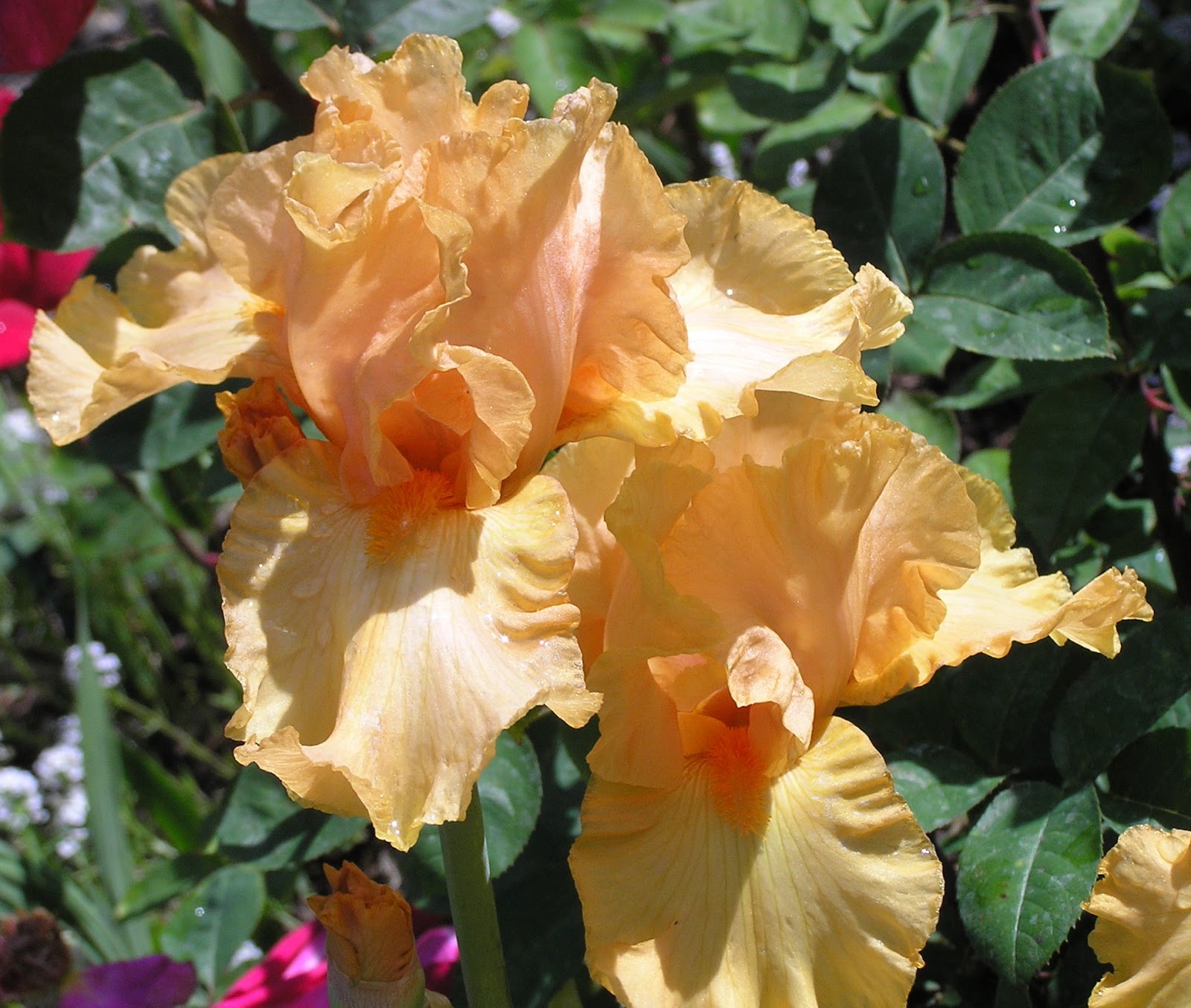
'Orange Pop' ( Larry Lauer, R. 1998). Seedling #91-189. BB, 26" (66 cm). Late midseason bloom. Ruffled orange self; beards orange; pronounced sweet fragrance. 'Role Model' X 'Gratuity'. Lauer's Flowers 1998. Honorable Mention 2000; Award of Merit 2002; Knowlton Medal 2004.

I wondered how, if left alone, iris could continue to grow and flourish, since the mess of rhizomes I was separating had been gorgeous and happy in 2010, and such a tangled mess in 2015. How could it be nature’s plan for this plant to survive without someone getting on their hands and knees, separating the rhizomes, and transplanting them a nice distance away from each other every few years? 

Whatever the answer, I realized how happy I was to have a role in the plan, to be the one that brings a little order to the chaos of the ‘Iris plan.’ Left alone, they become chaotic, they stop blooming. Iris lovers are needed to tend and care, separate and replant, arrange and maintain. And the reward is seen in the amazing blooms these plants produce when they’re given that little bit of order and care. What fun that is to see and be part of.

Of course, the balance of chaos and order is also and indoor/outdoor struggle for me. The more I’m outdoors keeping things organized and tidy in the garden, the more the indoors suffers for my absence. This time of year, though, Mother Nature is kicking me out of the garden, and giving me the opportunity to get the balance of chaos evened up. Sure, I’ve been spending some of that mandatory indoor time making labels, updating my database, blogging, and doing other things “Iris.” What do you expect? But I’m also bringing down the chaos in my domestic environment, getting projects done, and making my inside life easier and nicer. 

Which is good, because once those rhizomes start growing in March, I will be running–not walking–back out in the my garden, and spending my time with Mother Nature again! I know I’m not the only one who feels that way...

Also, any day that it’s not raining, or terribly cold, I will be outside, checking on the beds, changing the balance of chaos indoors for ordering in the garden. The chaos is built in, and I’m ok with that.
'Wintry Sky' ( Keith Keppel, R. 2002). Seedling 95-14A. TB, height 36" (91 cm), Early midseason bloom. Standards steeplechase blue (M&P 43-HG-11) central area shading to light blue (42-AB-6) edge, midrib flushed foxglove (42-GH-9); style arms light blue (42-AB-3); Falls blue white (42-A-1/2), foxglove shading in throat beside beard; beards cream at end, yellow in throat, with blue base; heavily ruffled. 'Crowned Heads' X 91-165A: ( 'Spring Shower' x 'Modern Times'). Keppel 2002. Honorable Mention 2004; Award of Merit 2006; Wister Medal 2010.

Sunday, December 6, 2015

A Grateful Gardener

Somehow, it is once again Sunday night, and even though it’s December, the weather today was just magnificent, and I was able to work outside in the garden all day. I am a lucky so-and-so, I just know it. There are plenty of locales where iris are deep under the snow already, and the fact that it was 70°F in our area today is decidedly unusual for this time of year, but not so rare that I was unprepared. I worked outside until it was too cold and too dark to stay out, so of course I consider today to be a roaring success.

There isn’t much for me to do in the iris garden these days, as pretty much everything is planted, and the hatches have been battened down for a few weeks. Well, I will admit to still working on getting name tags finished and into the beds, but I have my layout in an xl file, so I can focus on that when it’s actually too cold or wet out to be IN the garden. And speaking of name tags, I am in the continuous search for a more efficient and long-lasting way to label my rhizomes.

Currently, I am using the metal staked tags with printed labels. The label media is weather resistant, which is good because before we knew better, we used whatever label cartridge came with the printer, and all our labels (and that was over 100 of them) faded in one season. What frustration. I am still in the process of remembering names and trying to match them to blooms each Spring... Having learned my lesson, I now use the metal staked tags, and weather-ready labels.

I also write the name of the rhizome on the back of the tag with a paint pen, so that if the tag should fade or peel, the name is still preserved on the back. This has worked well in previous years, but for some reason, this year my pen is, er, what’s the nice word... inconsistent? Irregular? Here’s what I mean:

Well, it’s good enough for the backside, right? Ahem... at least I can tell what the name is supposed to be if the front side gets ruined. No style points, though, ha ha.

I’ve also painted a few of the backsides completely, creating a dark, solid field. I will experiment with using a china pencil (white or yellow) on those as the alternate label, and report my findings.

Additionally, I’ve got some weather-resistant labels on plastic knives, which are great in beds that don’t have a gardener near them. I put the label on the blade portion of the knife, then stick the handle-end into the ground, with the label facing away from the sunniest/hottest direction. Not effective if you have sheep or other critters moving through the beds... it’s a long story, which I’ll save for another post.

In the meantime, I’d love to hear what methods you use for labeling your rhizomes. I have heard of several very clever and attractive methods, and I bet you have some good ideas to share... hmmm?

But, I’m saving labels for rainy/cold days. Today was not that day, and again, I feel lucky! Being able to go outside for hours at a time and (comfortably) work in my yard is just my favorite thing to do. It feeds my soul. It makes me happy. It heals me. It brings me joy. And at the end of the day, or to be more precise, at the end of the daylight, when I look around and can see the difference my time and efforts have made, I have an enormous sense of accomplishment that few other things bring me.

I think gardeners in general are very lucky people. We have a bit of land, a bit of time, a bit of nurturing, and a bit of nature in us. We have a desire to work with nature, the patience to wait for the results, the creativity to choose and plant, and the time to give to our gardens. Those are traits to be admired and cultivated, no pun intended! I know in our local iris society there aren’t too many member under the age of 45... I also know it’s very expensive to buy a house, and most people in their 20s and 30s have kids which absorb the kind of free time required to garden. Nontheless, I have a hope that gardening, and iris gardening in particular, continues to be popular, not only for the sake and beauty of the plants, but also for the traits and qualities gardening engenders. My favorite people are gardeners.

I would love to know how you were introduced to gardening, and iris gardening in particular. Please feel free to share that in the comments section below, or you can write to me through this blogsite. We compassionate, patient types have to stick together! I’m grateful for my garden, and what it brings me. I’m also grateful for my gardening friends—they’re lovely people, and I’d really enjoy adding you to my list of gardening friends.

The weather will go back to normal late-fall temperatures tomorrow, and the nights have been hovering near freezing. Leaves are coming off the trees in steady droves. I will be “stuck” inside soon, since I don’t have the toughness to garden in cold and wet conditions. You can bet I’ll be sitting at the window, peering out at the leaf-covered yard, watching it rain, anticipating the new growth we’ll see in the Spring. My labels will be finished, and in the beds before the end of the month, I’m sure. Then, we all wait while nature works her miracles. How lucky are we?

As promised, a gorgeous blooming iris, to keep us warm until the Spring

Jaguar Blue' (George Sutton, R. 2001). Sdlg. G-57. TB, 36" (91 cm). Midseason late bloom. 
Heavily ruffled ethyl blue (lighter than RHS 112D); beards ethyl blue, hairs tipped pale yellow; edges serrate; slight sweet fragrance. 'Silver Flow' X 'Silverado'. Sutton 2001


Monday, November 23, 2015

“All Ya Gotta Do Is...”

Well, another Sunday night finds me winding down from a fantastic weekend of gardening, as Mother Nature graced us with weather in the 70s (I know!) and being serious about stretching out my gardening season as much as possible, I stayed outside!

And to my complete delight, I had excellent company and help from my partner in this project, Chris, and my darling husband, too. So much more got accomplished by having them here, and it was just so enjoyable having their delightful company. Thanks to them both for their help and presence! A combination of tasks were at hand, and although I didn’t finish everything for Phase II, it’s very close:


As you can see, there are still two beds waiting for iris, but the dirt is in, and all I’ve got to do is dig up iris from my property, separate them, clean them up, plant them in the bed, feed and Preen them, and install irrigation. So, for all practical purposes, Phase II is done. (Let me just have that for a moment... the reality will still be there when the moment has passed.) And although today was 73° the prediction is that the high Wednesday will be 48° so I’m actually very serious about getting the work done right away.

These beds hold a combination of named iris from purchases made recently (some growers are still shipping to our climate!), named iris I had at my personal property, named iris from friends and family, and a huge quantity of unnamed iris from my personal garden. One of my only frustrations as an iris gardener has been how difficult it is to keep names and plants together. I have been undone by mother nature (the sun, the water), sheep, gardeners, dogs, and my own lack of maintenance. I’m being very diligent about keeping the names and layouts for this project in a database, so that even if the name tags disappear, I will know what is where in which beds. Progress! All I’ve gotta do it is make sure the rhizomes aren’t moved from their beds!

The large center section has two iris in it: at the very center is a smaller section of Denver Dawn (see photo below) and the outside edges are a beautiful heirloom yellow iris that I got from a lovely woman in Encino about a decade ago. I love this story, as it illustrates how iris are a social plant: I drove past her house daily on my way to and from work, and she had a zillion yellow iris on her front slope. When they all bloomed every Spring they were just gorgeous. I finally went to her house with a shovel, a 5 gallon pot, and cash. I knocked on her door to ask her if I could possibly buy some, and she graciously refused my cash and took my 5 gallon pot instead! Sadly, she never knew the name, so I chose them simply for their beauty. I think I only took about 10 or 12 of her rhizomes even though she easily had over 100 on the slope. I have found that people who love iris are generally very generous about sharing their excess fortunes, wink wink... Anyhow, when I separated them this month, I had over 100 rhizomes myself. They will make fantastic centerpiece for the iris in the outside beds.
'Denver Dawn' (John Durrance, R. 1965). Sdlg. 58-90. TB, 40" (102 cm). Midseason late bloom. Color Class V1P, Self with subtle infusion of mauve and rose. 'Pierre Menard' X Loomis plicata sdlg. Long, Cooley 1964.

The other task that is already presenting itself is weed management in the areas around the beds. We’ve had some rain already this season, with more coming soon, and the green sproutlets are rapidly becoming a proper field of weeds. There has been more hoeing (thanks to my darling husband), and Preening of course. Hopefully we can stay on top of it throughout the wet season. All I’ve gotta do is just keep up with the rain and the sun!

While my darling husband was weed massaging (heh), Chris and I addressed the hundred or so rhizomes that had been dug up in previous years, and stored (rather badly) at my property. Some were from my mother’s garden, some were from my personal property, and all of them deserved to be planted at least 12 months ago. Believe it or not, there were still quite a few viable rhizomes in that collection of papery mess, and after choosing an appropriate spot to give them their best shot, we cleaned them up and got them planted. I shall be interested to see what we get from them in the Spring. All I’ve gotta do is feed them, water them, and beg them to forgive me!

And earlier this week, I brought home seven buckets of rhizomes I dug up from an impacted and neglected bed at my mother’s house. They’ve been out of the ground since the first weekend in October, and while I know there are irisarians out there screaming at me to not dig them up until I have space ready for them to immediately go into, I don’t always have that luxury, and I have to admit to having exceptionally good survival rates, and thriving plants. The bearded iris are all now planted in one section together, as the gardener at my mother’s house had mangled and separated some of the names, and removed others altogether. I have a rough idea of what iris were in that particular bed, so I’ll keep them all together, and as they bloom I’ll label and move them. In the meantime, they are hunkering down for a nice wet Winter.*

The bulk of the transplant, however, was spuria, and they did not do so well out of the ground for so much time. So, they look rather pathetic, and their names are all unknown. I gave them a spot where I can keep an eye on them, keep them moist, and baby them if needed. We shall see if they make a comeback... All I’ve gotta do is hope for a miracle.

Now that the Phase I and Phase II sections are (mostly) done and there are over 100 iris in each section, I’m really getting excited about Spring. There are 100 or more iris in beds throughout the property and I’m having so much fun visualizing all the color, all the beauty that will erupt in March, and carry on through May, and possibly even into June. Once again, I am reminded that iris are a social plant, because they cause me to stop and talk to strangers, invite people into my garden, and even write a blog. I’ve already made some wonderful friends through iris society meetings, visiting local growers, and stopping by to chat with neighbors who have iris in their yards (that’s how I met Chris!). I am really looking forward to all the people that iris will bring into my yard this Spring. Maybe one of them will be you. All ya gotta do is come by.

*As I was going through old photos looking for a good image of Denver Dawn, I found a series of photos my mother had taken in 2010, including a series of close-ups of the names of the iris I dug up in October and just planted this week at our project property. It was such a surprise to see those photos, and it felt like a gift, and put me in tears. I am pleased to list the names of the transplanted iris:

Snowed In
Mariposa Wizard
Midnight Mink
Princess Bride
Follow That Dream
Starlight Waltz
Crowned Heads
Mild Manner
Obsidian
Expose
Alpenview
Classic Look
Whipped Frappe
Wintry Sky
April in Paris
Returning Rose
Deliciously Different

Thanks, Mom!


Sunday, October 11, 2015

Gardens: the mystical place where one hour becomes nine

Although I work, and have eight dogs, ten sheep and an orange cat (orange cat owners know what that means) I somehow manage to spend the bulk of my time gardening. I do this by choice, and on days like today, I do it instead of all the things I should be doing. (Note: if anyone can tell me the four-letter word equivalent for “should” I’ll use that instead.)

I have two forms of proof that I spent the bulk of my weekend in the garden. First, the inside of my house could convince you that border collies have opposable thumbs, and second, I am finally making visible progress on our iris project. While I dream of coming home to a beautifully clean home and a delicious, fresh-cooked meal, it turns out—to my surprise—that I’m the wife, and am the one traditionally obliged to complete those tasks. Normally, my utterly darling husband steps up and makes a huge dent in the household chores, but he is out of town this weekend, and so I come home to the mess I made yesterday, after a long day in the garden... (Honey, did I mention how much I appreciate you? Consider this a second reminder that you’re the best.)

So, now it’s 9:30 at night, I’m eating from-the-freezer stir-fry, and having just unloaded and re-loaded the dishwasher, I can now sit down and gush and crow and preen over my garden photos (none of which show the true measure of the accomplishment I feel!). I’m that delightful combination of excited and bushed, which is a nice way to wrap up the weekend. And I get to share my progress photos with you, which makes it much more fun. But first, of course, I have to tell you what got done!

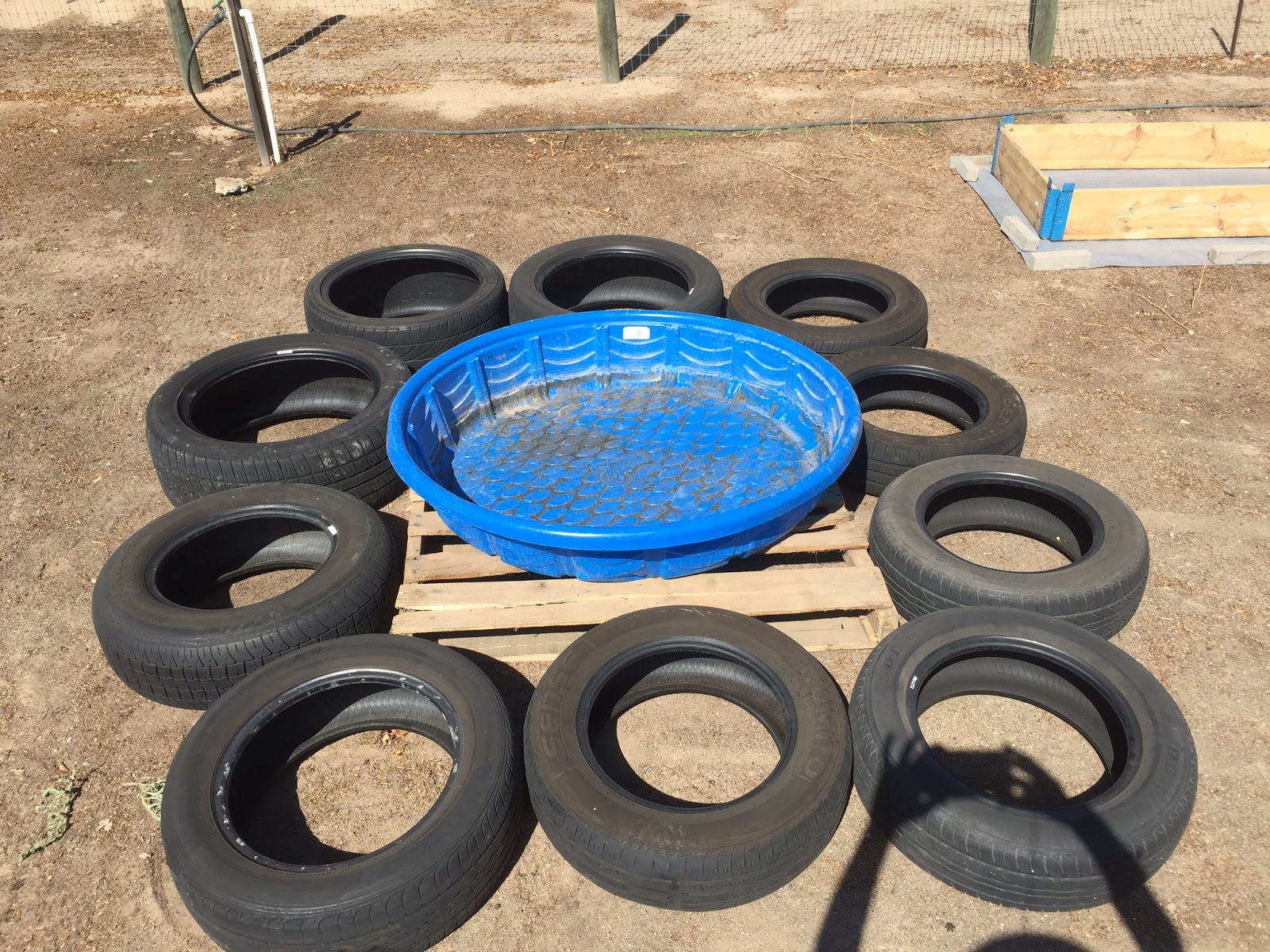
From previous posts, know you that I’d cleared an area of the yard with a gentle slope for our great planting endeavor. I also procured (donated!) kiddie pools, tires, and pallets. Drip irrigation materials are on hand, and the iris have all arrived (bought online, and from the San Fernando Valley Iris Society, who are just the loveliest people around). It was down to soil, and as also discussed in previous posts, planting directly into our (awful) soil is just an invitation to feed gophers and ground squirrels. Soil of a higher quality had to be obtained, and to keep it brief, the stars finally aligned for that to happen, and lucky me, six yards of very nice loamy, amended soil was delivered. Yaaaaaay!


P.S. Whomever came up with the expression “dirt cheap” has never had a dump-truck load of it delivered to their house.

“Hooray!” I exclaimed. “I can start planting now!”

But, that was premature. Because, you know, I’m not just going to stick them in the beds willy-nilly. There has to be a plan! A grand scheme! An over-arching concept! Right? I mean, I’m starting from bare dirt in about an acre of land. This is my big chance to design something amazing, and brilliant. Something that will end up in high-end gardening magazines, and be the first result when you search “gorgeous iris garden” and also be the ideal for all future iris lovers across the globe. I can’t just stick them in a kiddie pool and call it genius! There must be A Plan!

This, friends, is where the magic of gardening begins to ebb away, and the practical realities of being a Type-A overachiever with tendencies towards the grandiose starts to inhibit the actual gardening part of having a garden. I kid you not, there are probably a dozen steps between the dirt arriving, and the first iris rhizome getting planted in that dirt. I’ve had a few sips of wine, so it’s starting to be amusing to me...feel free to laugh along with me.

The good news (for me) is that in addition to being Type-A, I’m also very practical. I realized that I was not quite ready to design the most stunning garden of all time, and that just having a successful growing season was an excellent goal for this first planting year. Sufficiently self-chastened, I took some (more) advice from my sister, and created a visual catalog of all the iris I ordered, as well as all the named iris I already own. It turns out to be approximately 85 named iris. (The hundreds and hundreds of iris with missing names have earned their own post, so we’ll talk about those another time.) Luckily for me, I used to be an art director and graphic designer, and I very quickly assembled an excellent and clever (if I do say so myself) method of creating my very own iris catalog. Arrange-as-you-like printed envelopes:

This way, I can lay them out to create optimal color combinations without trying to drag my computer around the garden. Or worse, relying on my memory...
All the tags and labels that come with the rhizome go into the envelope. I feel so clever.

Of course, my goals for the garden are different from most commercial growers’ goals and requirements. I could have just planted them alphabetically! Or by type (“Tall beardeds on the left, folks, and intermediates on the right...”), but I created a slightly more challenging rubric of by-season and by complimentary-color combination. Which is to say, all the early bloomers are together, and then arranged in color combinations that enhance and support the beauty and uniqueness of each variety. Then the mid-season bloomers are together, and the late bloomers are together, etc, all arranged by a totally subjective and probably not-entirely-perfect color-enhancement and combination that, now that I’m typing it, sounds almost silly.

But, truly, a lot of thought went into which iris should be planted near which other iris. In my personal yard, I have what I call my yellow garden. I have combined many of my favorite yellow and yellow-adjacent plants in one area, and they all bloom their own variety of yellows, creating a really lovely and inviting spectacle. But I noticed when iris-shopping that often all the white iris (for example) look indistinguishable when they are planted together. There are subtle differences, of course, but the eye wearies of all white, or all blue, or all deep purple. And creating contrasts, and appealing color combinations really boosts the value of some of the more average or mundane blooms. A plain-ish yellow bloom becomes dull next to another plain-yellow bloom. But either of them in contrast with a vibrant purple (or reds, or pinks) become a vital part of a visually exciting tableau. Yeah, I just said that!

So, I printed out all the named iris stats onto envelopes, in full color. Then I separated them into bloom season (early, mid, late). And then began the fun of deciding which combinations of rhizomes should be created, and into which kind of bed (tires, raised beds, or kiddie pools) they should be planted. Now, I am going to toot my own horn again, and say that normally I am very very good at estimating how much time a task will take. And normally, I will brag about how that is one of my superpowers. Because of that, I will happily confess that I grossly, massively, and completely underestimated how long it would take me to create the layouts for the beds.

I figured it would take about an hour. It took closer to four. That’s with help from Chris. And that was after I had printed the envelopes, broken them into bloom-season groups, and made a preliminary layout. I was utterly unable to make the process faster, and I suddenly understood the appeal of planting them in alphabetical order.

When I woke up this morning at seven, I thought I would have everything planted by noon. Looking back, that is so naively adorable! I wrapped at sundown, because I still needed hardware and knew I wouldn’t get back before dark. Also, the dogs called and were threatening to see what they could whip up from leftovers and whatever was in the freezer... I had to call it a day. All the mid-season bloomers are planted in the raised beds, and the late-bloomers are the next to go in.

The great news is that I think we have a very attractive layout for each bed, and we will be able use all three types of beds for this test planting. Once I paint the tires for the early bloomers (because black tires in our climate will simply bake the roots of any rhizomes), they can get planted, too. I then have the drip system installation, and then... well, if you garden, you know there will always be something else. It will probably be weeding. I’m convinced the runoff will create beautiful green stripes of weeds in downhill rivulets from our beds... and then the gophers will really have something to think about!

Before that, though, here is a pictorial of how today proceeded:

It started out hot today, so we set up in the shade. You can see our magical raw materials: 
tires, raised beds, and lots of rhizomes. A thousand thanks to Chris for her help and company.


You don’t have to guess that it’s genius at work when you see we are using the hood of the car 
to lay out our magic envelopes and create the masterful final designs (cough, cough).


So, ha, I was pretty convinced we were going to need dozens of beds and walkways for the all the iris I ordered... and ha-ha, uh, no. This is pretty much the final configuration: early bloomers in the tires, midseason bloomers in the raised beds, and late bloomers in the kiddie pools. (Results may vary.)


Taken from the downslope, this all the room it takes to plant approximately 120 rhizomes. 
Yeah, I was surprised, too!


It looks, um, well, right now, see, they’re not painted yet, so they’re not really camera-ready, and so, well, it’s going to be, um, probably, like, you know, good. In the end. Maybe ignore this shot.


This is where most of the magic happened today. We laid out weed-blocking fabric, 
and then on top of that, we rolled out fine-grade wire mesh, to discourage the below-ground critters from coming up into the beds from underneath. I use the word “discourage” realizing 
they may come through anyhow, but at least we made it challenging!


So, here you can best see the wire and the weed-blocking fabric. 
This is such a tidy look, I hope they stay this nice looking throughout the season. Stay tuned.


Ah, finally! Rhizomes in the ground! Once we have the layout officially in our database, I will 
go through and remove all the lovely tags, so they can just look natural. And relaxed. Like me.


You, too, can work for nine hours and have this to show for it! 
Check again in the spring though, and then tell me what you think.
Me? I’m utterly tickled, and can’t wait to get outside tomorrow and plant some more!


And because I promised, here’s an iris for you to enjoy

Part of a long, tragic history of iris that were separated from their name tags. 
If you think you know the name, please let me know!